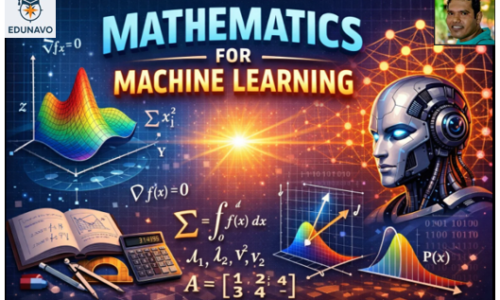
Machine learning algorithms rely heavily on mathematical concepts. This course provides a strong mathematical foundation required to understand how machine learning models work internally.
The Mathematics for Machine Learning course covers the essential mathematical tools used in modern AI and data science, including linear algebra, calculus, probability theory, and statistics. These concepts are explained with practical Python examples so learners can connect theory with real-world machine learning applications.
Through this course, students will learn how vectors and matrices represent data, how derivatives and gradients help train models, how probability distributions describe uncertainty, and how statistical techniques support data analysis and decision making.
The course combines mathematical intuition with hands-on coding using Python libraries such as NumPy, SciPy, SymPy, and Matplotlib. By the end of the course, learners will be able to apply mathematical concepts to understand machine learning algorithms like regression, optimization methods, and probabilistic models.
Linear algebra concepts used in machine learning
Vector and matrix operations using Python
Eigenvalues, eigenvectors, and matrix decomposition
Differential calculus and gradients for optimization
Gradient descent and optimization techniques
Probability theory and common probability distributions
Bayesian reasoning and conditional probability
Statistical concepts including hypothesis testing and confidence intervals
Students learning machine learning or artificial intelligence
Data science beginners who want strong mathematical foundations
Engineers transitioning into AI and analytics
Professionals preparing for machine learning roles
Python
NumPy
SciPy
SymPy
Matplotlib
Scikit-learn
MIT Linear Algebra Course
https://ocw.mit.edu/courses/18-06-linear-algebra-spring-2010/
Internal Links