
Description
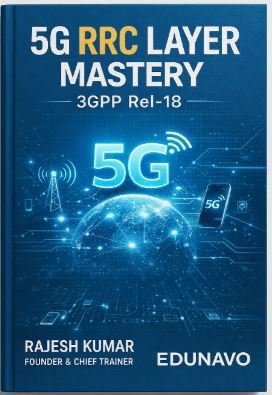
5G RRC Layer Mastery – 3GPP Rel-18 is a deep, implementation-oriented reference book focused entirely on the 5G NR RRC (Radio Resource Control) layer, written with a protocol engineer, tester, and troubleshooting mindset.
Unlike high-level theory books, this e-book explains how RRC actually works in live 5G SA networks, covering state transitions, signaling procedures, timers, counters, measurements, paging, security, and IRAT mobility, fully aligned with 3GPP TS 38.331 (Rel-18) and related specifications.
The book follows a step-by-step procedural approach, enriched with:
Exact 3GPP clause references
Calculation examples (SFN, SSB, paging PF/PO)
Message flows and ASN.1 references
Real lab and failure scenarios
Interview-oriented explanations
This makes it suitable both as a learning guide and a day-to-day protocol reference.
📚 What This Book Covers
🔹 RRC State Management
RRC_IDLE, RRC_INACTIVE, RRC_CONNECTED
All state transitions with triggers and procedures
RRC Setup, Release, Resume, and Re-establishment flows
🔹 Cell Search & Synchronization (5G SA)
GSCN concept and global frequency raster
SSB time-domain and frequency-domain positioning
SSB slot/symbol mapping (FR1 & FR2)
SSB frequency offset and positioning calculations
🔹 MIB, SIB & System Information
Detailed MIB bit-level breakdown
PBCH payload structure and decoding logic
SIB1 purpose, size, scheduling, and TBS calculation
Practical examples of payload → CRC → channel coding
🔹 Paging (Rel-18 Aligned)
Paging purpose and message structure
PF & PO concepts
DRX-based paging calculation (simple & complex cases)
ETWS / CMAS / SystemInfoModification handling
🔹 RRC Timers & Counters
RLM counters (N310, N311)
T300, T301, T302, T310, T311, T319, T320, T380
State-transition timers with failure behavior
🔹 Signaling Radio Bearers (SRBs)
SRB0 to SRB5 roles and priorities
Usage in standalone, EN-DC, and NR-DC scenarios
Security activation dependencies
🔹 RRC Services & Functions
Services provided to upper layers
Measurement configuration & reporting
Mobility management, QoS handling
Beam management and BWP control
🔹 AS Security (With Key Derivation)
Integrity & ciphering rules
KRRCint, KRRCenc, KUPint, KUPenc derivation
Step-by-step KDF examples using HMAC-SHA-256
Reconfiguration with sync and resume impact
🔹 Measurement Events & Gaps (Rel-18)
Events A1–A6, B1, B2
Rel-18 additions: B1-NR and B2-NR
Measurement objects, report configs, meas IDs
FR1 / FR2 measurement gap configurations
🔹 IRAT Mobility
Complete IRAT handover flow
RRC, NGAP, S1AP, GTPv2 signaling sequence
IRAT failure reasons and optimization strategies
Lab-based troubleshooting examples
🧠 Key Strengths of This Book
✔ Strictly 3GPP spec-aligned (Rel-18)
✔ Calculation-driven explanations, not just theory
✔ Covers real failure cases & fixes
✔ Ideal for log analysis and debugging
✔ Excellent for interview and on-job reference
👥 Who Should Read This Book
5G RAN / RRC Protocol Engineers
5G Testing & Validation Engineers
L3 / System Integration Engineers
Telecom Trainers & Researchers
Serious learners preparing for telecom product company interviews
📖 Specifications Referenced
3GPP TS 38.331 (RRC – Rel-18)
TS 38.213, 38.214, 38.215 (PHY & measurements)
TS 33.501 (Security)
TS 38.413, 29.274 (IRAT signaling context)
Internal Links
External Links
3GPP TS 38.331 (RRC – Rel-18)
TS 38.213, 38.214, 38.215 (PHY & measurements)
TS 33.501 (Security)
TS 38.413, 29.274 (IRAT signaling context)

Saurabh Mishra –
This book explains 5G RRC concepts in a very clear and systematic manner. Topics like RRC state transitions, Resume, Re-establishment, and Paging are explained with proper flows and real scenarios, which helped me a lot during troubleshooting.
Kavita Joshi –
An excellent reference for anyone working on 5G Layer-3. The coverage of MIB/SIB, SSB positioning, timers, and counters is very detailed and aligned perfectly with 3GPP TS 38.331 Rel-18.
Arjun Patel –
I really liked the way complex topics like AS security context, key derivation, and RRC Reconfiguration are explained with step-by-step examples. This book is extremely helpful for both interviews and live network analysis.
Neha Singh –
The explanation of Measurement Events, Measurement Gaps, and IRAT handover flows is outstanding. The content is practical and clearly written from a real telecom engineer’s perspective.
Imran Khan –
This e-book is a must-have for 5G protocol engineers. The Rel-18 updates, clean diagrams, and standards-based explanations make RRC concepts very easy to understand and apply in real projects.
Deepak Kumar –
The explanation of RRC states (IDLE, INACTIVE, CONNECTED) with trigger conditions and procedures is extremely clear. The state transition diagrams helped me understand paging and resume behavior in real networks.
Pooja Mehta –
This book made RRC timers and counters very easy to understand. Topics like T310, N310, RRC Re-establishment, and failure scenarios are explained with practical clarity, which is very useful for troubleshooting.
Aman Gupta –
The coverage of SSB positioning, GSCN, MIB/SIB decoding, and SFN calculation is excellent. Numerical examples helped me connect theory with what we see in protocol analyzer logs.
Farhan Ali –
I found the chapters on AS Security Context and key derivation extremely valuable. The step-by-step explanation of KgNB, KRRCint, and KRRCenc is rare and very well presented.
Ritu Saxena –
A very well-structured and standards-aligned book. Measurement events, IRAT handover flows, and paging calculations are explained in a way that directly helps in interviews and real deployment analysis.